Log in


Table of Contents
- What Is the Entourage Effect?
- Is the Entourage Effect Real? What Science Says
- How the Entourage Effect Works in Cannabis
- The Entourage Effect and THC
- The Ratio that Matters: CBD:THC
- What Does the Entourage Effect Feel Like?
- Full Spectrum vs Broad Spectrum vs Isolate
- How to Experience the Entourage Effect
- The Bottom Line: Why the Entourage Effect Matters
If you’re at all familiar with cannabis, you’ve heard of the entourage effect. It’s the idea that all the compounds in the cannabis plant—cannabinoids, terpenes, flavonoids, and others—work better together than on their own. Working from there, full-spectrum products may have more balanced effects than broad-spectrum or isolate products.
It makes a lot of sense, and there is some promising research. The thing is, we still don’t have big human clinical trials to offer a definitive answer. If you’re curious about the entourage effect, here’s what to understand about how it might work and what it could mean next time you’re choosing cannabis products.
What Is the Entourage Effect?
The entourage effect is a hypothesis that all of the compounds in cannabis might have a synergistic effect that’s different from what happens when they’re individually isolated. In plain English, the whole plant might act differently in the body than any single compound would on its own.
Where the Term "Entourage Effect" Came From
An Israeli chemist named Raphael Mechoulam, along with his colleague Shimon Ben-Shabat, gets credit for dreaming up the term. Mechoulam is the same guy who isolated and synthesized THC in the 1960s. In a 1998 paper, they observed that specific metabolites seemed to boost the activity of a specific endocannabinoid in a way that didn’t happen with the active compound alone. They called it the entourage effect (1).
A cannabinoid researcher, Ethan Russo, took the idea further in a 2011 review when he argued that phytocannabinoids and terpenes seem to work better together (2). That paper is when the scientific cannabis community really started to pay attention to the idea of the entourage effect.
Why It Matters When Choosing a Cannabis Product
If you think the entourage effect sounds logical, it might steer you toward full-spectrum products over those made with broad-spectrum and isolates. It all comes down to choosing what works for your goals. And just like cannabis, those are personal.
Is the Entourage Effect Real? What Science Says
The entourage effect is still a hypothesis supported by research and not yet a settled scientific fact. The issue is that we don’t have comprehensive human clinical trials to really tell us one way or the other, so for now, it’s best to consider it plausible but not yet proven.
Modern Studies Supporting the Entourage Effect
Russo, who popularized the concept, revisited it in a 2019 review that included substantial preclinical evidence for synergy between terpenes and cannabinoids (3). In 2021, a study found that four cannabis terpenes produced cannabinoid-like behaviors in mice, and that some of those effects were blocked by cannabinoid or adenosine receptor antagonists. The authors called it the first evidence that terpenes and cannabinoids produce an additive effect (4). A recent comprehensive review lands in the same spot as most researchers: the potential of individual terpenes is worth exploring, it’s not yet proven, and clinical trials are still needed (5).

How the Entourage Effect Works in Cannabis
It all seems to come down to interactions between naturally occurring compounds in cannabis. The main players appear to be cannabinoids and terpenes, along with flavonoids and other plant compounds.
Cannabinoids
Cannabinoids are the chemical compounds that interact with the body’s endocannabinoid system. The big ones are delta-9 THC (tetrahydrocannabinol) and CBD (cannabidiol), but there are over 100 identified cannabinoids (6). Here’s a (very) short list:
Terpenes
Terpenes are aromatic compounds that give plants their distinct scents and flavors. It’s why lemons are so bright and zesty, rosemary is so herbaceous, black pepper is so peppery, and some cannabis strains are so distinctly skunky or diesel-y. Here are some of the most common terpenes in cannabis:
- Myrcene
- Limonene
- Linalool
- Pinene
- Caryophyllene
- Humulene
- Terpinolene
How These Compounds Interact in the Endocannabinoid System
The working theory is that cannabinoids and terpenes may actually impact each other’s activity, and it’s more than a one-plus-one-equals-two scenario. Russo’s paper includes a few interesting examples related to receptor binding, changes in blood-brain barrier permeability, and neurotransmitter effects.
Interestingly, there are two types of entourage effects for cannabis-derived compounds. Intra-entourage describes interactions between cannabinoids or terpenes, while inter-entourage means interactions between cannabinoids and terpenes.
The Entourage Effect and THC
While the “entourage effect” is a single concept, it doesn’t describe just one thing. The influence of those surrounding plant compounds really depends on which cannabinoid they’re surrounding. The THC version of the entourage effect is pretty defensible.
What Is the Entourage Effect with THC?
The entourage effect theory holds up well when it’s applied to THC. It falls into the intra-entourage effect camp, though clinical evidence suggests that minor cannabinoids measurably influence the overall activity of a specific extract.
How Terpenes Shape a THC High
The popular story is that terpenes — which really do give cannabis strains their unique tastes and smells — are what actually influence effects. Myrcene for couch-lock, limonene for an uplifting experience, linalool to support sleep, or so the thinking goes. There is some measured activity in the data, but none that demonstrates terpenes actually change what THC does. Until that changes, the better interpretation is that terpenes probably shape the experience through flavors, aromas, and general expectation.
The Ratio That Matters: CBD:THC
There’s good evidence that CBD modulates THC, and it happens in two different ways. One changes how THC interacts with the CB1 receptor, and the other inhibits certain liver enzymes, which slows down THC’s conversion to 11-hydroxy-THC, the more potent psychoactive metabolite. That’s why CBD is considered an entourage compound for THC.
What Does the Entourage Effect Feel Like?
Self-reported data is really where we get information about the entourage effect in practice. Here’s what that looks like.
Reported Sensations from Full Spectrum Products
People who take full-spectrum products often describe the experience as more balanced, more well-rounded, more even, and less “sharp” compared to single-compound products. The onset is often described as smoother and more gentle, and the comedown tapers instead of dropping.
How the Feeling Differs from Single-Cannabinoid Products
One-note cannabinoid products are usually described as feeling predictable and more linear. It has less to do with intensity than with the overall feel. Alone, THC is described as feeling sharper and more cerebral. Add CBD, and the same dose often feels more manageable. That’s not just perception, either. Remember, CBD changes THC’s behavior through two different mechanisms.
Individual Variation: Why It Feels Different for Everyone
People respond to cannabis differently. Metabolism, body composition, consumption habits, even expectations and the surrounding environment all influence the experience. That’s why what works for one person may not work for another, and why everyone should abide by the golden rule: start low and go slow.

Full Spectrum vs Broad Spectrum vs Isolate
The big difference between full spectrum, broad spectrum, and isolate products is their range of compounds.
Full Spectrum: The Complete Entourage
Full spectrum cannabis products are made with the full profile of plant compounds. That includes THC. To be federally compliant, hemp-derived products cannot exceed 0.3% THC by dry weight.
Broad Spectrum: Entourage Without THC
Broad spectrum cannabis products contain all of the compounds except THC. The idea is that users benefit from the synergistic effects of almost everything.
Isolate: No Entourage Effect at All
Isolate CBD or other cannabinoids are single compounds, so they’re working solo. There’s no entourage effect with these products.
How to Experience the Entourage Effect
If you want to test this theory for yourself, here’s how to shop accordingly.
Choose Full Spectrum Over Isolate
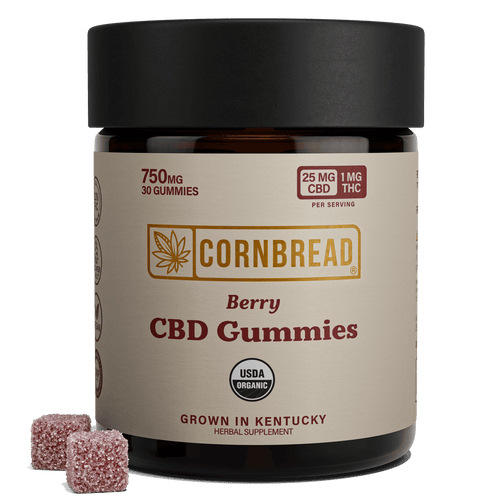
This is the whole ballgame, so look for full-spectrum extracts to ensure you’re getting all the cannabis plant has to offer. Cornbread Hemp has federally compliant THC gummies (including THC sleep gummies), THC drinks, CBD gummies, and CBD sleep gummies, all of which are made with our proprietary Bluegrass Basin Hemp. And yeah — it’s full spectrum.
Look for Products with Cannabinoid Ratios (CBD:THC)
This is the part of the entourage effect with the best evidence, so it’s worth keeping in mind. Products with a helpful CBD-to-THC ratio give you an idea of how the experience will land. More CBD relative to THC usually means a smoother, more manageable ride than with THC alone. Our THC gummies have a 1:1 ratio for exactly that reason.
Check for a Terpene Profile on the COA
The certificate of analysis is a third-party lab report with all sorts of useful information. Check the cannabinoid profile, the THC dosage compared to what’s on the label, the pass/fail results for contaminants and — if it’s available — the terpene breakdown. It’s not a predictor of effects, but it does tell you that the extract retained plant compounds beyond the major cannabinoids (and also that the brand tests thoroughly enough to report them).
Start Low and Observe the Difference
If you want to keep this scientific, take a low dose of a full-spectrum product, wait an appropriate length of time for effects to become noticeable, and then consider how you feel. The next session, use an isolate with a similar cannabinoid dose to the first product and repeat the process. Notice what feels different, and remember that your results are the only ones that apply to you.
The Bottom Line: Why the Entourage Effect Matters
The entourage effect is a fascinating theory, and it makes a lot of sense. Why wouldn’t all of the plant’s compounds work better together than they might apart? Just remember that it’s still a theory, and science is still catching up to anecdotal evidence.
If you want to test it yourself, opt for high-quality, full-spectrum products from brands like, ahem, yours truly. Always buy from the ones who publish full COAs, check that CBD:THC ratio, and remember to start low and go slow. From there, we recommend trusting what you actually notice over what labels promise.