Log in


Table of Contents
- How Much CBD Oil Should You Take?
- What Factors Affect Your CBD Oil Dosage?
- CBD Oil Dosage Chart by Body Weight
- Starting CBD Oil Dosage for Beginners
- CBD Oil Dosage for Specific Goals (Sleep, Anxiety, Pain)
- How Long Does CBD Oil Take to Work?
- How to Adjust Your Dose Over Time
- Are There Side Effects to CBD?
- Will CBD Oil Make Me Fail a Drug Test?
- How to Choose High-Quality CBD
- The Brand I Trust
- Bottom Line: How Much CBD Oil Do I Take?
If you’re new to cannabidiol, the first question is almost always: how much CBD oil should I take? It’s a fair question. Since CBD products aren’t standardized like over-the-counter medications, dosing can feel a lot like guesswork. The fact that bottle sizes, concentrations, and CBD types all vary from brand to brand makes things trickier. The simple truth is that there is no one-dose-fits-all for CBD oil.
That’s where this guide comes in. We’re breaking down a reasonable starting dose, how to adjust it by body weight, what research says about dosing for specific goals like sleep, stress, or discomfort, and general timelines.
How Much CBD Oil Should You Take?
Most people start with 20-25mg of CBD per day and adjust from there based on their body weight, how they respond, and what they’re trying to accomplish. As with all things cannabis, there is no “correct” dose. Clinical research has tested CBD oils in amounts ranging from 20mg to over 1,500mg per day (yes, really!). But starting low and increasing gradually is the best approach, as recommended by doctors and pharmacists (1).
What Factors Affect Your CBD Oil Dosage?
CBD dosage is personal, since everyone responds to cannabidiol in their own way. That means the optimal dose for you depends on personal factors like your body weight, metabolism, and genetics, as well as why you’re taking CBD oil and how your body reacts to it initially and over time as it acclimates to regular use (1). That’s why a single dosage recommendation doesn’t apply to everyone and why that 20-25mg starting dose is more of a starting point, not a hard-and-fast rule.
CBD Oil Dosage Chart by Body Weight
Body weight is one of the biggest factors in finding your starting dose. Generally, the more you weigh, the more CBD it takes to feel an effect. Use this chart as a starting point, then adjust based on how your body responds.
|
Body Weight |
Starting Dose |
Typical Range |
|
Under 130 lbs |
15–20 mg/day |
20–40 mg/day |
|
130–230 lbs |
20–25 mg/day |
25–60 mg/day |
|
Over 230 lbs |
25–30 mg/day |
30–100 mg/day |
Cornbread Hemp offers two CBD oil formulas built for different times of day. Our Distilled CBD Oil is formulated for daytime use. The 750mg bottle has a lighter THC ratio (0.5mg THC per 25mg CBD serving), so it's less likely to cause drowsiness. Our Whole Flower CBD Oil is formulated for evening use and offers a higher THC ratio (2mg THC per 50mg CBD serving) to support sleep. Either can serve as your starting point on the chart above—we recommend reaching for the Distilled oil during the day and the Whole Flower oil at night.
Starting CBD Oil Dosage for Beginners
If you’re new to CBD, remember the golden rule: start low and go slow. Begin with a low dose, around 20-25mg per day, and give your body time to adjust before increasing. It can also be more effective to split your total dose across the day than to take it all at once. For instance, if you’re starting with 20mg per day, try taking 10mg in the morning and 10mg in the evening for more consistent absorption.
Keep a journal of your dosing and how you feel so you have something to review after a week or two. Our free CBD Relief Journal makes it easy to stay organized.

CBD Oil Dosage for Specific Goals (Sleep, Anxiety, Pain)
The right starting dose can vary depending on why you’re using CBD oil.
CBD Oil Dosage for Sleep
For evening use, many people start with 25mg of CBD oil about 30 to 60 minutes before bed. Cornbread’s Whole Flower formula has a higher THC to CBD ratio, which is designed to support relaxation so you can drift off. Since CBD works best with consistent use, give it a few days before deciding whether your dose needs adjusting.
CBD Oil Dosage for Stress and Anxiety
For daytime stress support when you don’t want to feel tired, the standard starting dose of 20-25mg is a good place to begin. Pay close attention to how you feel. While some people find relief at a lower dose, others will need to gradually ramp up to a higher dose range spread across the day. Again, everyone is different, so plan for a little trial and error as you dial in your dose.
CBD Oil Dosage for Pain and Discomfort
Most people find that a base dose of 25-50mg per day, split into two servings, helps ease pain and discomfort. If discomfort flares up on top of your regular dose, a breakthrough dose (see below) is a good option instead of permanently increasing your daily dose.
To be clear, these recommendations are just starting points, not medical advice. You should always check with your doctor before using CBD, especially if you’re managing a specific health condition or taking any medications.
How Long Does CBD Oil Take To Work?
Remember, cannabidiol doesn’t work overnight like magic. You probably won’t feel a huge difference the first time you try it, so try to be patient. Research on full-spectrum, hemp-derived CBD products has found that continuous use over several weeks leads to clinical and cognitive improvement, which supports the idea that CBD tends to work best with consistent, regular use instead of sporadic, one-off doses (2). Many people find that for physical discomfort specifically, it takes a few weeks of consistent use before they notice a difference.
How To Adjust Your Dose Over Time
Once you’ve settled on a starting dose, stick with it—and be consistent. You want to take the same product at the same time of day for about a week to evaluate how you feel. This becomes your base dose: the amount that reliably works for you day after day.
From there, you can experiment with a breakthrough dose of CBD oil. That’s a little extra on top of your base dose for days when you need more support. If you notice that your base dose isn’t giving you the results you want, consider it a sign to increase your serving size or the frequency with which you take it.
Are There Side Effects To CBD?
The World Health Organization has found that CBD shows no evidence of abuse or dependence potential and that its use isn’t associated with public health problems (3). It’s generally well tolerated and has a good safety profile. Still, some people may notice side effects such as reduced appetite, diarrhea, or fatigue, though these are more common at higher doses. You cannot overdose on cannabidiol. However, check in with your doctor or pharmacist before beginning a CBD regimen if you're taking prescription medications in order to avoid experiencing any drug interactions or side effects.
Will CBD Oil Make Me Fail A Drug Test?
Federally compliant full spectrum CBD oil contains trace amounts of THC (less than 0.3%), so there’s a small chance it could cause a positive drug test. And that risk isn’t limited to full-spectrum CBD products alone. Broad-spectrum and isolate CBD can occasionally trigger a positive result as well, since many workplace drug tests can’t distinguish between CBD and THC.
If you get tested at work, check with your HR department before starting CBD. Topical CBD products may be a better choice, since cannabinoids don’t absorb through the skin to the bloodstream as readily.

How To Choose High-Quality CBD
A lot of CBD products out there are unregulated, and quality varies dramatically. These products may contain harmful materials or have a lower potency than what you expected. Here are some things to take notice of when shopping for hemp-derived CBD products.
Check The Source
The most important thing to research first is where the company grows and processes its hemp.
Hemp is a bioaccumulator, meaning it absorbs whatever’s in the soil it’s grown in—including contaminants like pesticides, fertilizers, herbicides, heavy metals, and more. That makes sourcing transparency important: look for brands that disclose where their hemp is grown and can show soil and lab testing to back it up, regardless of country of origin.
Cornbread Hemp is built on 250 years of Kentucky hemp tradition. Our CBD oils are made with only two ingredients: USDA organic Kentucky hemp extract, which is processed with organic sugarcane ethanol, and USDA organic coconut oil. What more do you need?
Look For USDA Organic
Once upon a time, all hemp farmers in America grew pesticide-free hemp. That changed when the EPA approved pesticides for hemp farmers (4). All of these things matter for your health and safety. Some products may contain heavy metals leached from the soil or from solvents used in processing that were not properly removed.
An easy workaround? Look for USDA-certified organic CBD oil. That’s the best way of ensuring you’re getting a safe CBD product that’s free of toxins.
Third-Party Lab Tested
You want to make sure that whatever CBD product you are buying has been fully tested by a third-party laboratory. Why must it be a third party? Because then you can trust that the results were not edited or tampered with by the manufacturer.
Lab results should include potency and pesticide reports, as well as reports on residual solvents, mycotoxins, heavy metals, and microbial contaminants in the sample. A good CBD brand will make it easy for customers to find their product's lab reports, or certificates of analysis. The best companies will have a QR code on the product label that you can scan with your phone to access the report directly.
Can You Trust A CBD Label?
Is the advertised amount of CBD actually in the bottle? Not always. A 2026 review in Phytochemistry Letters pooled data from 28 studies testing nearly 1,000 CBD products and found that only 31% were accurately labeled, with approximately 10% of their stated CBD content (5). Some products also tested positive for heavy metals, residual solvents, or synthetic cannabinoids. That’s why it’s so important to buy CBD from companies that provide a current certificate of analysis.
The Brand I Trust
Cornbread Hemp is a family-owned CBD company that sources their hemp from Kentucky. They use organic sugarcane ethanol to gently process the hemp cannabis extracts they use as a base for their products. Cornbread Hemp is the first company in the region to attain a USDA-certified organic seal on their CBD cannabis oil. That's a big deal!
To create Cornbread Hemp USDA-certified organic CBD oil formulas, organic cannabis extract is blended with organic MCT coconut oil. This is a better carrier oil than other choices like olive oil or hempseed oil because MCT oil molecules are smaller, which helps to penetrate skin membranes.
Third-party lab reports are available for every product on their website; they even have scannable QR codes on every box to easily access the COA's. Another feature that sets Cornbread Hemp apart is the CannVerify authentication code on every package. This safeguards consumers from purchasing counterfeit merchandise.
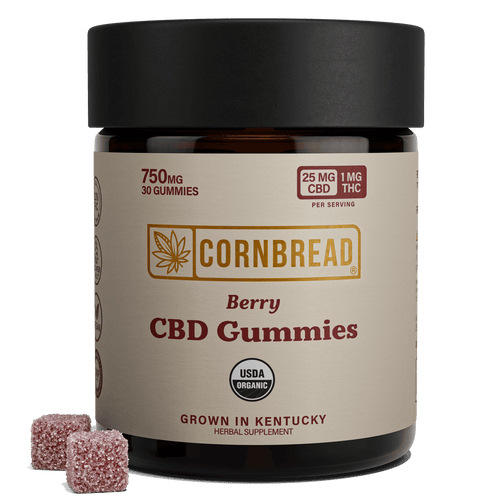
This brand excels in "high quality." They offer USDA organic CBD oil in multiple strengths, along with CBD cream, CBD gummies, and an oil for pets.
Bottom Line: How Much CBD Oil Do I Take?
Circling back to our original question, “How much CBD do I take?” The answer: the ideal CBD dosage is unique for each person. We recommend one dose of 25mg CBD each day as a starting point, while monitoring your response over time. You will likely need to increase or decrease the CBD dosage as needed to adjust for your specific needs and health and wellness goals.
There is no one-size-fits-all approach to cannabidiol wellness. It depends on many factors, including your specific body chemistry, the type of CBD you choose, and your chosen delivery method. But with some time and mindfulness, you will find the correct CBD dose to get your desired effect.