Log in


Table of Contents
- How CBD May Support Sleep
- Recommended CBD Dosage for Sleep
- CBD vs THC for Sleep: Which Works Better?
- When to Take CBD for Sleep (Timing Matters)
- CBD Gummies vs CBD Oil for Sleep
- The Bottom Line: How Much CBD Should You Take for Sleep?
Of all the reasons people use CBD, sleep support is a big one. CBD, or cannabidiol, isn’t a traditional sleep aid—it doesn’t knock you out like prescription medications do, and it’s not a sedative. But this non-intoxicating cannabinoid can have calming effects. For people navigating the kind of anxiety or physical discomfort that makes it hard to fall and stay asleep, CBD can be a viable option.
The key is dosing CBD properly for sleep, and there’s really no simple answer here. If you’re researching how much CBD to take for sleep, here’s what to know.
How CBD May Support Sleep
CBD interacts with the body’s endocannabinoid system, a complex signaling network responsible for managing all sorts of biological processes. That includes temperature regulation, immune response, pain, mood, and yes, sleep and relaxation (1). There are three parts to the endocannabinoid system:
- Cannabinoid receptors are scattered throughout the body—the brain, central nervous system, organs, and other tissues.
- Endocannabinoids are created in the body and bind with ECS receptors to trigger specific reactions.
- Enzymes break down endocannabinoids once they’ve done their job.
CBD is a phytocannabinoid in the cannabis plant, but it’s so similar to the body’s own endocannabinoids that it can interact with the endocannabinoid system. That’s the reason that consuming cannabis has such a profound effect compared to, say, broccoli.
The interesting thing about CBD is that it doesn’t bind directly to receptors, the way THC (tetrahydrocannabinol) does. Instead, it appears to have a modulating effect, including preventing enzymes from breaking down cannabinoids and endocannabinoids, which can lead to stronger effects. That extended interaction might help the endocannabinoid system maintain balance.
So, what does that mean for sleep? CBD’s ability to influence the endocannabinoid system can help create a calm, relaxed state (2)—exactly what you want before you drift off. If your sleep issues stem from a racing mind or nighttime restlessness, CBD could make a significant difference.
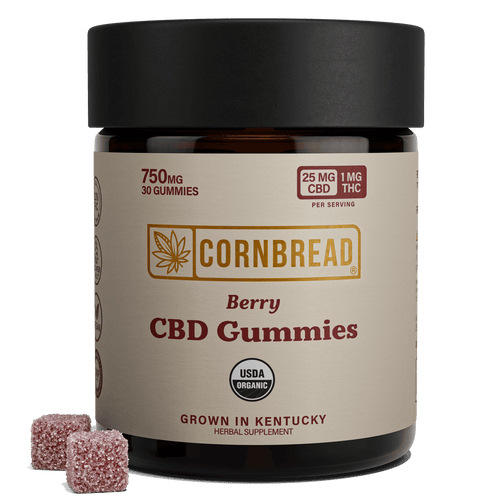
CBD Sleep Gummies from Cornbread Hemp are also melatonin-free, which means no next-day grogginess. Our formula includes sleep-supporting botanicals, like valerian root, chamomile, and lavender, alongside USDA organic, full-spectrum CBD.

Recommended CBD Dosage for Sleep
There is no universal dosage chart for CBD, whether you’re using it for sleep support, daily wellness, or to ease aches and pains. Everyone responds to CBD differently, because individual factors like metabolism, tolerance, consumption habits, and even body weight all influence effects. That means a little trial and error is in order.
Our CBD Sleep Gummies come in 750mg, 1,500mg, and 2,250mg potencies for beginner, intermediate, and experienced users.A serving is a single gummy. If you’re new to CBD, we recommend starting with the lowest potency for a serving of 75mg. That might sound like a lot, but CBD has biphasic properties, which means it produces opposing effects at different dosages. Lower doses tend to promote focus and a feeling of alertness, while higher doses are more likely to make you feel tired.
Here’s another consideration: CBD builds in the system over time, so consistency is important. If a single gummy isn’t giving you the results you hoped for after a week or so, you can try upping your dose with two gummies or upgrading to a more potent formula. The key is to practice patience.
CBD vs THC for Sleep: Which Works Better?
We already covered how CBD interacts with the endocannabinoid system. THC is different. It binds directly to CB1 receptors in the brain, creating a sense of deep relaxation in the body and mind. Unlike CBD, THC does have sedative effects. That may help you fall asleep faster. Short-term THC use may be helpful, but large-scale studies have linked chronic, daily cannabis use with increased wakefulness and lower sleep efficiency (3).
If you're choosing between CBD and THC for sleep, you don't necessarily have to pick one. A full-spectrum formula with a low-level THC gives you the benefits of both without the tolerance and sleep-disruption risks that can come with higher THC doses. That’s what you get with Cornbread’s CBD sleep gummies. They’re federally compliant, and because they contain the full profile of compounds in the hemp plant, they contribute to what’s known as the entourage effect. That’s when cannabinoids work together to produce stronger results than CBD alone.
For sleep specifically, that small amount of THC may help round out CBD’s calming effects without the wakefulness issues linked to heavier, chronic THC use.
If you're looking for a more noticeable THC effect, Cornbread also has THC Sleep Gummies. They have a higher THC ratio alongside CBD for a stronger relaxation effect before bed. As with any THC product, start with a low dose and give it time to take effect before taking more.
When to Take CBD for Sleep (Timing Matters)
When the goal is sleep support, timing is as important as dosing. The general recommendation is to take a gummy (or two) 30 to 60 minutes before bedtime. Gummies need to be digested, so this gives your body enough time to metabolize the CBD and complementary botanicals.
A few things to keep in mind:
- Empty vs full stomach. Eating a gummy on an empty stomach can speed up absorption. Taking it with, or right after, a meal, especially one high in fat, can slow the onset but improve overall absorption.
- Individual metabolism. Depending on how quickly your metabolism works, you might notice effects faster.
- Consistency. Since CBD builds up in the system with regular use, taking it around the same time every night tends to produce more reliable results.
If you’re new to CBD gummies for sleep, a good starting point is to take them an hour before you actually want to be asleep—not just before you get in bed. That way, the onset lines up with when you’re winding down instead of lying in bed staring at the ceiling.

CBD Gummies vs CBD Oil for Sleep
CBD oil is a little different from CBD gummies. The best time to take CBD oil for sleep support is closer to bedtime, about 20 to 30 minutes before you get into bed. CBD oils are best taken sublingually for more rapid absorption into the bloodstream, which means a quicker onset of effects. On the other hand, since gummies are processed more slowly through digestion, many people find their effects last longer than oil, even at a similar dose.
A few other considerations: oil is easier to fine-tune in small increments. The dropper allows for micro-adjustments, while gummies come in fixed doses per piece. But gummies are probably more convenient: they’re pre-dosed, easy to take on the go, and they mask the natural hemp taste that’s harder to overlook in oil form.
So which one is better for sleep? It depends on how quickly you need to fall asleep and how precisely you want to control your dose. If you tend to lie awake for a while before drifting off, the faster onset of CBD oil may suit you better. If you want a consistent, no-guesswork routine, gummies make that easier.
The Bottom Line: How Much CBD Should You Take for Sleep?
There’s no single right dose of CBD for sleep, but a good starting point is 25–75mg, taken 30–60 minutes before bed, with a bit of patience while your body adjusts. Remember to start low and go slow—it’s the golden rule of cannabis consumption, and there’s really no scenario where it doesn’t apply. Give any new dose about a week of consistent use before deciding whether to increase it.
If you’re interested in giving CBD a chance to help improve your sleep, Cornbread Hemp's CBD Sleep Gummies are a good place to start. They’re USDA organic, full-spectrum, and melatonin-free, so you can wake up feeling rested without the grogginess.